
Understanding the Three Stages of Ranking in Search Engines
Your ranking in Google search engine results is one of the most important elements of running a website. In fact, it is the most important for many. This is especially true for businesses, especially in e-commerce, which usually want to reach as many people as possible.
There are three main stages of ranking in search engines. You need to ensure that you can be found at all, you should make sure that your website’s content is high quality and directly relevant to the intended subject matter, and a focus should be placed on gaining as much authority within that field as possible.
Fortunately, so much of what goes into simply improving the quality of your website ultimately enhances its standing with search engines, but do also take into account the big picture.
Table of Contents
1. Crawling: The Discovery Stage
In many cases, you do not need to do anything in order to get your website discovered, as Google and other search engines do much of this type of work automatically. This is done through crawling, which notes the contents of the webpages that have been discovered. However, that is not where analyzation takes place. The crawlers forward this information to where that is done.

As far as the crawling stage goes, you should ensure that it is being done while also noting that, in many cases, only a portion of your website is being crawled while the rest is not. Additionally, the speed at which your website is being crawled is an important consideration, especially if you are posting time-sensitive content that you want to be quickly discovered by search engines.
Regularly updating your website will usually increase that speed as well as how often it is crawled.
To see which parts have been indexed by a search engine, head there and type “site:” immediately followed by your domain name with no spaces between “site:” and it.
One of the most significant ways that you can help crawlers out is by having an easily navigable website. For example, are links to your important web pages posted on your homepage? Keep in mind that any that require logging in or the completion of a similar step to access will not be crawled.
Conversely, you may want some of your web pages to not be discoverable. Blocking crawling is possible as well.
What can prevent crawling?
Pages can be blocked or missed for several reasons, including robots.txt rules that restrict crawler access, server errors that prevent pages from loading, orphan pages with no internal links pointing to them, and overly complex site architecture that crawlers struggle to navigate.
Conversely, you may want some pages to remain undiscoverable. Blocking crawling through robots.txt is possible.
2. Indexing: The Analysis Stage
Indexing plays a crucial role in the world of Search Engine Optimization (SEO), as it directly impacts how search engines interpret and affect ranking factors in your website’s piece of content. In essence, indexing is the process of deciphering the information presented on your website to determine its relevance to searchers or users’ search queries.

For effective indexing, it’s imperative to ensure that your website hosts high-quality content aligned with at least SEO basics, keywords, and topics you aim to rank for. For instance, if your website specializes in selling bags, your content should revolve around running-related subjects such as types of bags, luxury bags, eco-friendly bags, and the latest bags. However, topics unrelated to your niche, like woodworking or microbiology, should be avoided to maintain relevance.
The frequency of indexing is influenced by various factors, including the frequency of updates and the volume of traffic your website receives. News websites with a global reach, for example, are indexed more frequently than newer websites focusing on niche subjects such as Georgia’s peaches.
To exert more control over indexing, webmasters can utilize techniques such as adding noindex meta tags to specific pages and signaling search engine bots to exclude those pages from their indexing process.
So, in SEO marketing strategy, indexing ties closely with metrics such as organic traffic, which refers to visitors who find your website through unpaid, organic search results. By ensuring effective indexing, you can enhance your website’s visibility and attract more organic traffic, ultimately boosting its performance in search engine rankings.
Moreover, indexing intersects with other SEO strategies such as keyword research, link building, citations, title tags, and optimizing meta descriptions. Implementing relevant keywords strategically throughout your content can improve your website’s indexing and ranking for those terms. Similarly, building quality backlinks from reputable sources and crafting compelling meta descriptions can enhance your website’s visibility and click-through rate (CTR) in search results.
Furthermore, indexing is pivotal for maximizing the functionality of your website, ensuring that it delivers the most relevant and valuable content to users. By focusing on indexing and providing relevant content, you can enhance user experience, increase engagement, and drive conversions.
In summary, indexing serves as a critical stage in the SEO process, influencing various metrics, including organic search traffic, social media visibility, and ultimately, conversions. By prioritizing relevant content, optimizing for indexing, and employing effective SEO strategies, you can improve your website’s visibility and performance in organic search results.
What can prevent indexing?
Even if a page is crawled, it may not be indexed. Common reasons include noindex meta tags that tell search engines to skip the page, duplicate content that offers no unique value, thin or low-quality content that fails to meet quality thresholds, and pages blocked by robots.txt after crawling.
To control indexing, webmasters can add noindex meta tags to specific pages to exclude them from search results.
3. Ranking: The Ordering Stage
A significant focus for many is the third stage: ranking. That is when a search engine decides where to place your website in its search engine results pages.
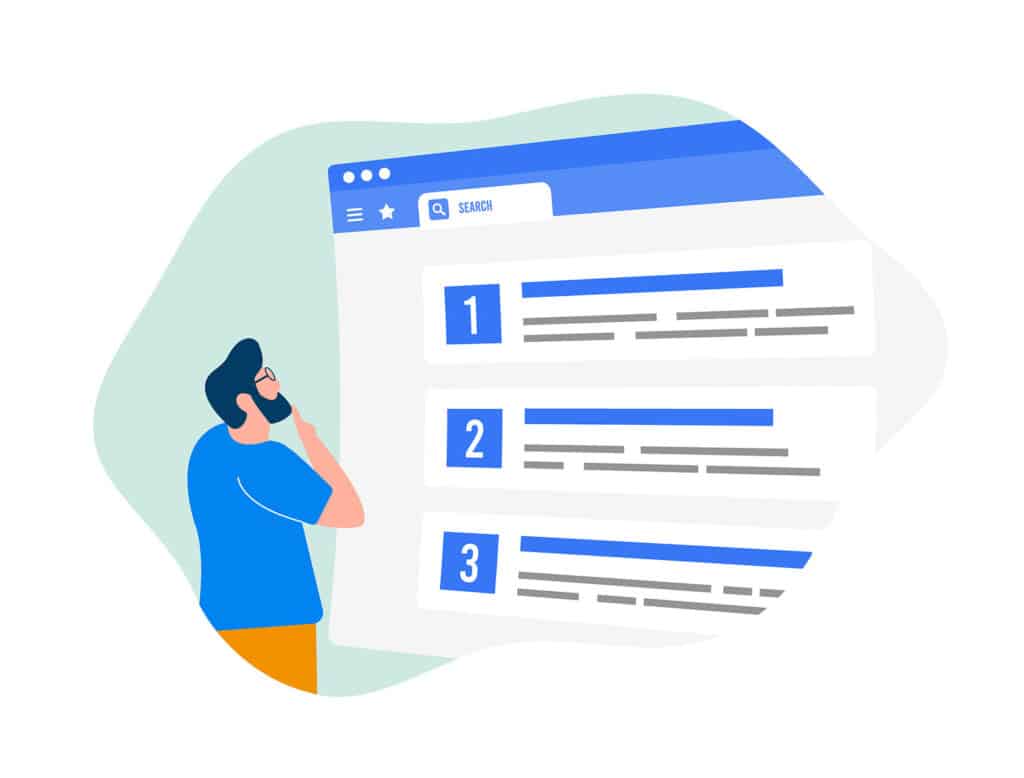
If you are fortunate enough to have yours at or near the top of its SERPs, the number of click-throughs that you receive will be significant compared to your competition. This does not only result from increased visibility, through more eyes seeing your website on the SERPs. It is also related to credibility as, for example, surfers tend to view websites that Google ranks highly as more reputable than others.
To determine where to rank webpages, search engines use regularly updated algorithms that take into account several factors.
The Role of Authority
Authority is one of the most important ranking factors. It is built primarily through backlinks, which are links to your website from external sources. A backlink from a high-authority site like Vogue to your fashion website carries significant weight. Well-placed internal links also communicate quality to search engines.
Domain trust, brand mentions, and consistent high-quality content all contribute to authority over time. Some SEO frameworks treat authority as its own distinct stage because of how critical it is to ranking.
User Experience
Improving the quality of the visit for the average person should be your primary focus. This is also why search engine algorithms change so frequently. Their intent is to direct people to websites that give them the best experience.
Focus on page speed, security (HTTPS), and mobile-friendliness. Search engines also measure how long visitors spend on your pages. A particularly negative signal is when someone immediately leaves your site to choose a different result.
Conclusion
A way to look at this entire process is that you need to be discoverable in the first place and then combine that with posting quality content while doing your best to ensure that people know about it. Missing any of those three stages will result in your website not reaching its full potential.
If it is discoverable and has much more strength in one of the remaining two stages than the other, the weaker one should generally be your focus.
Keep in mind that these usually overlap some. For example, continuing to improve your website’s quality will help create high-value backlinks. However, if you are especially behind in authority, you should spend considerably more time on that than you would if you were already trusted in that field. Solely creating more content, regardless of how much quality it has, will not suffice.
If you would like assistance with any of these three stages or with otherwise enhancing your search engine optimization (SEO), on-page SEO, SEO strategy, content marketing or digital marketing, technical SEO, local SEO, and other SEO efforts, reach out to us at SEO North.
FAQ
What are the three stages of ranking?
