Semantic clustering is the process of grouping data points, especially text, based on their underlying meaning rather than surface-level characteristics like shared keywords or categorical identifiers. Instead of relying on exact word matches, semantic clustering uses natural language processing (NLP) and machine learning algorithms to understand contexts, relationships, and meanings within data.
For businesses working with large volumes of unstructured data (support tickets, customer feedback, social media posts, survey responses), semantic clustering transforms raw text into organized, actionable insights.
Table of Contents
How Semantic Clustering Works
Traditional clustering methods group data points by numerical or discrete attributes. Semantic clustering takes a different approach by analyzing the meaning behind the words. The process typically follows three stages.
Text Embedding
Raw text is converted into numerical representations called embeddings. These are high-dimensional vectors that capture the semantic content of each data point. Transformer-based models like BERT and its variants are commonly used for this step because they generate embeddings that reflect contextual meaning, not just individual word definitions.
For example, “the medication caused nausea” and “the treatment made me feel sick” would produce similar embeddings despite sharing almost no words.
Clustering Algorithm
Once data points are embedded, a clustering algorithm groups them based on vector similarity. Common approaches include hierarchical clustering, which builds nested groupings at different levels of granularity, and density-based methods, which identify natural clusters without requiring a predefined number of groups. The choice of algorithm depends on the dataset size, the desired number of clusters, and whether the data has a known structure.
Optimization and Validation
The final stage involves evaluating cluster quality. Metrics like silhouette scores and coherence measures help determine whether the clusters are internally consistent and distinct from one another. This step often requires iteration, adjusting parameters, re-running the algorithm, and comparing results until the groupings produce nuanced insights that reflect genuine thematic patterns in the data.
Semantic Clustering vs. Traditional Clustering
The key difference comes down to what each method uses as its basis for grouping.
Traditional clustering methods rely on structured inputs: numbers, categories, or exact keyword matches. They work well for quantitative data but struggle with free-text data where the same idea can be expressed in dozens of different ways.
Semantic clustering bridges that gap. By operating on meaning rather than syntax, it can group a complaint about “long hold times” with one about “waiting forever to talk to someone.” This capability makes it far more effective for any use case involving natural language.
That said, semantic clustering is more computationally expensive and requires careful selection of embedding models and clustering parameters. It is not a drop-in replacement for simpler methods when the data is already well-structured.
Real-World Applications
Customer Feedback Analysis
One of the most common applications is analyzing customer feedback at scale. Companies use semantic clustering to sort through thousands of support tickets, reviews, and survey responses to identify recurring themes. Rather than relying on keyword tagging (which misses variations in how people describe problems), semantic clustering surfaces patterns that would otherwise stay buried in unstructured data.
For example, a retail company might discover that a cluster of complaints about “packaging” also includes feedback about damaged products, missing items, and shipping delays, all related to the fulfillment experience even though the language varies widely.
Healthcare
In healthcare settings, semantic clustering is used to analyze patient feedback, clinical notes, and treatment experiences. Hospitals can cluster patient survey responses to identify systemic issues with staff interactions, service quality, or treatment protocols. Because healthcare language is highly variable (patients describe symptoms and experiences in very different ways), the semantic approach captures themes that keyword-based analysis would miss entirely.
Market Research and Consumer Sentiment
Market researchers use semantic clustering to analyze social media posts, product reviews, and focus group transcripts. By clustering responses around emerging trends and consumer sentiment, teams can identify shifts in public perception before they show up in structured survey data. This gives brands an early signal on issues like product dissatisfaction, competitive threats, or unmet needs.
SEO and Content Strategy
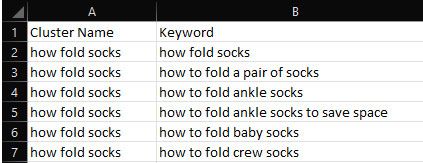
In SEO, semantic clustering refers to grouping keywords and topics based on related meanings and search intent rather than exact match terms. This approach helps content teams build topical authority by organizing site architecture around clusters of semantically related queries, improving both search engine rankings and user experience. It is the foundation of modern topic-based SEO strategy.
Tools and Software for Semantic Clustering
Several tools and libraries support semantic clustering workflows, ranging from open source libraries to cloud-based solutions.
Python NLP Libraries: Python remains the primary language for semantic clustering. Libraries like spaCy, NLTK, and Gensim provide text preprocessing and embedding capabilities. Scikit-learn offers a range of clustering algorithms that work well with text embeddings.
Cloud Platforms: AWS, Google Cloud, and Azure all offer NLP and machine learning services that can handle semantic clustering at scale. These platforms are particularly useful when working with large datasets that exceed local compute capacity.
Visualization Tools: Once clusters are formed, tools like Tableau and Power BI help teams explore and present the results. Visualization is critical for translating clustering outputs into strategic decision-making, especially when presenting findings to non-technical stakeholders.
Common Challenges
Semantic clustering is powerful, but it comes with real implementation challenges.
Data Quality Issues: Clustering is only as good as the input data. Noisy, inconsistent, or poorly formatted text produces unreliable clusters. Preprocessing steps like removing duplicates, normalizing text, and handling missing data are essential but often underestimated.
Scalability Concerns: Embedding large volumes of text and running clustering algorithms can be computationally expensive. Organizations working with millions of data points need to plan their data pipelines carefully, often leveraging cloud infrastructure to handle the load.
Integration with Existing Systems: Getting semantic clustering into production workflows requires integration with existing data pipelines and business intelligence tools. This is where many projects stall. The clustering itself may work well in a notebook, but operationalizing it across an organization requires engineering effort and cross-team coordination.
Choosing the Right Parameters: There is no universal “correct” number of clusters. Too few and the groupings are too broad to be useful. Too many and the results become fragmented. Finding the right balance requires domain expertise and iterative testing.
Driving Business Value with Semantic Clustering
When implemented well, semantic clustering delivers measurable ROI across multiple business functions. It enables operational efficiency by automating the categorization of unstructured data that would otherwise require manual review. It supports sales performance analysis by clustering win/loss reasons from CRM notes. And it drives innovation by surfacing patterns in customer feedback that structured data collection methods miss entirely.
For enterprise organizations, the real value is in turning qualitative data into quantitative insights at scale, making it possible to act on the voice of the customer rather than just measuring it.
FAQs
What is semantic clustering?
What is semantic clustering in SEO?
How is semantic clustering different from keyword clustering?
What tools are commonly used for semantic clustering?
What industries benefit most from semantic clustering?
Published on: 2022-03-28
Updated on: 2026-04-02
